Temporary Planetary Relationships in Divisional Charts: From Rasi or from the Varga chart Itself?
A Small Question with Big Consequences
Many important judgments in Vedic astrology ultimately depend on a simple question:
Is the planet comfortable in the sign where it is placed?
A planet placed in a friend’s sign can express its qualities naturally and give better results. A planet placed in an enemy’s sign finds it harder to function and may not produce its full potential.
In the birth chart (Rāśi chart), answering this question is straightforward. But things become less clear when we move to the divisional charts (Vargas). The classical texts do not give a clear answer, so different astrologers follow different approaches. Astrology software also differs, often without telling the user which method it has adopted.
This article examines that important question.
In earlier articles, we explored Natonnata Bala and Ayana Bala. Just as with Ayana Bala, there are two reasonable methods for calculating this factor. The difference is that, in this case, we can compare the two methods with practical examples and see which one gives more meaningful results.
The two kinds of friendship
Dignity has two moving parts: which sign a planet occupies, and how it gets on with that sign’s owner. The second part is itself built from two different ingredients, and they behave in completely different ways.
Naisargika maitri — the natural relationship. This is permanent and universal. It comes from the geometry of the planets’ own rulerships, and it never varies. The Sun and Venus are natural enemies in your chart, in my chart, and in every chart that will ever be cast. You could print this table once and use it forever.
Tatkalika maitri — the temporary relationship. This one is produced by the chart itself, and the rule is fundamentally about nearness. Look at where a planet sits, then look at the three signs ahead of it and the three signs behind. Any planet standing in that six-sign neighbourhood is a temporary friend. Anything further away is a temporary enemy.
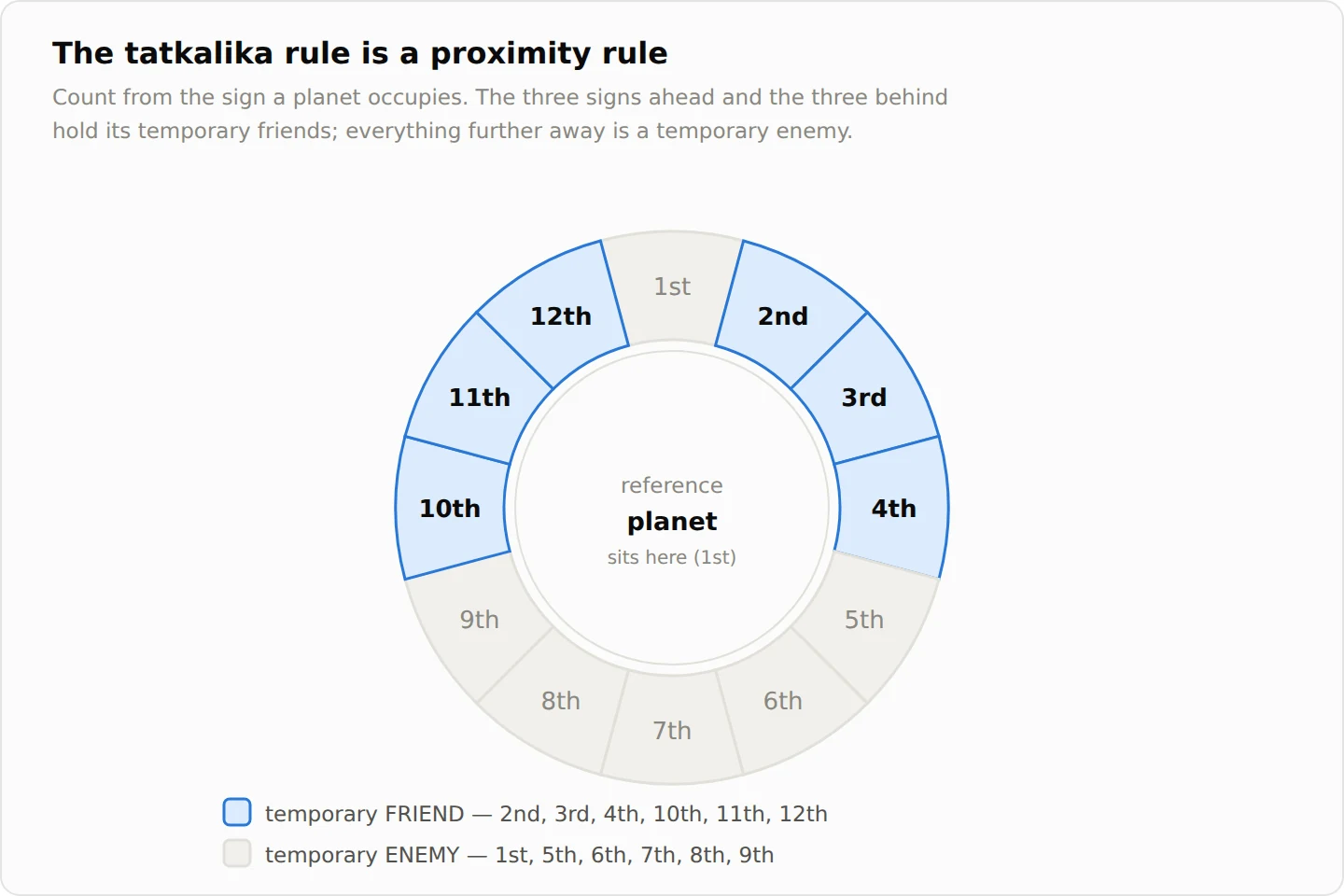
The two are then combined into a single verdict — panchadha maitri, the five-fold relationship:
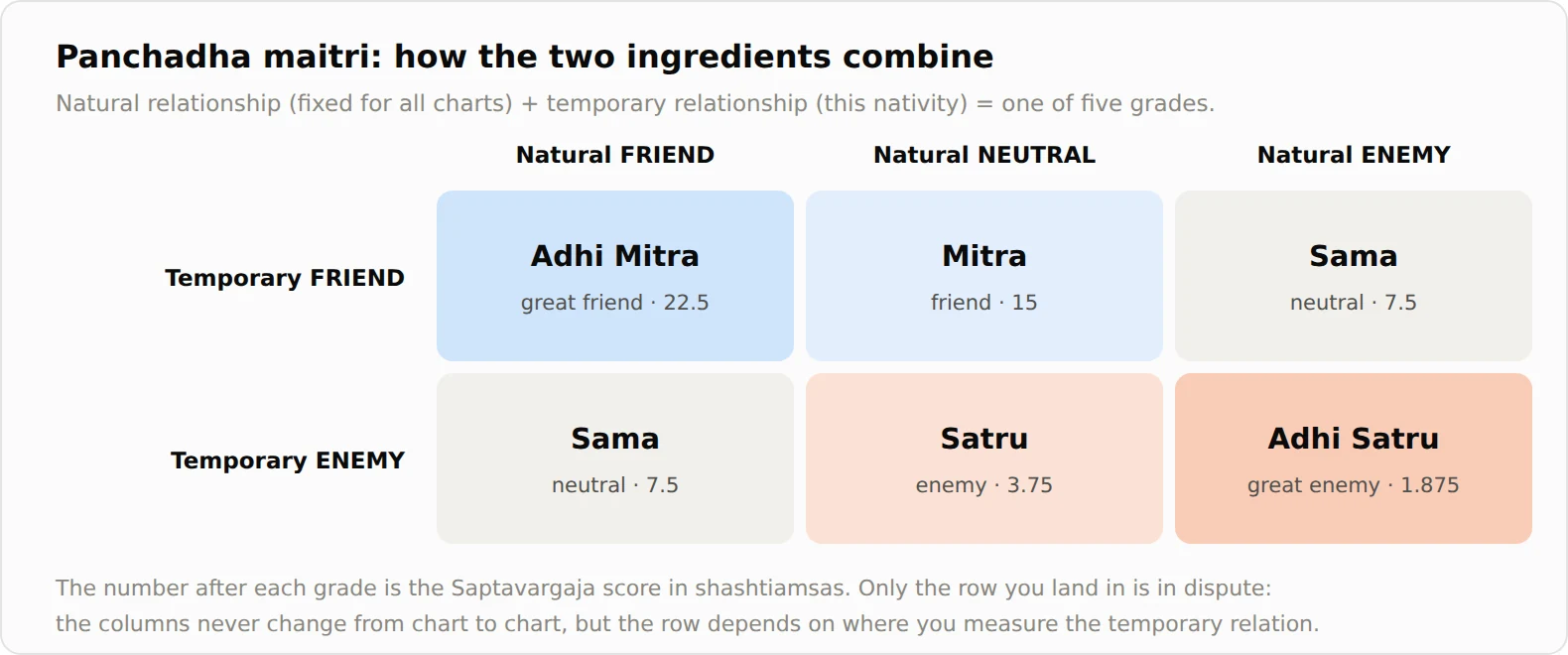
Look carefully at that grid, because the entire dispute lives inside it. The columns never change — natural friendship is a property of the planets themselves. Only the row is in question, and the row is decided entirely by the temporary relationship.
The fork in the road
Here is the question, stated as narrowly as possible.
You want to judge a planet’s dignity in, say, the Navamsa. You find which sign it occupies there, and who owns that sign. You now need the panchadha maitri between the planet and that owner. The natural half is settled — it never changes. But the temporary half has to be measured from positions.
Which positions? The ones the planets held in the birth chart, or the ones they hold inside the Navamsa itself?
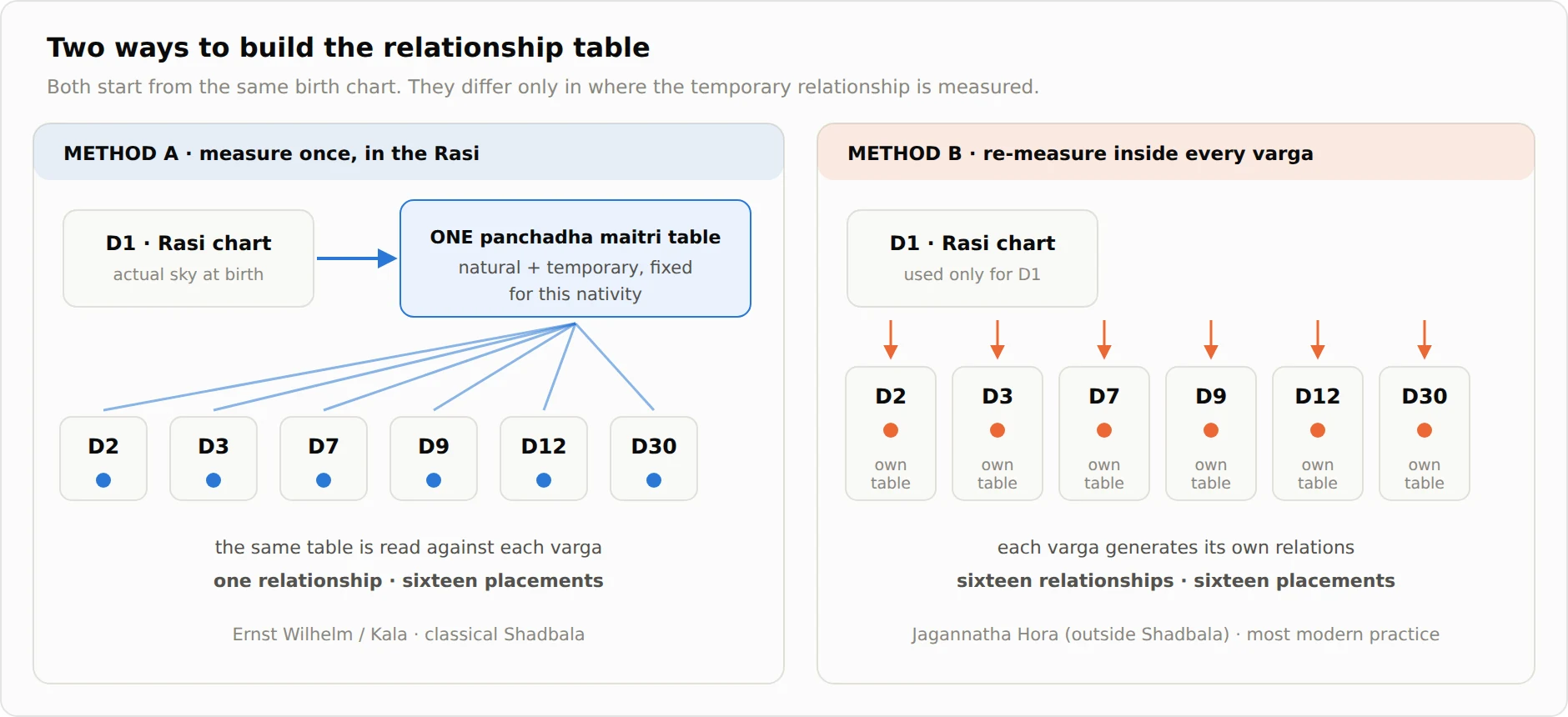
Both approaches are internally coherent. They are not reconcilable, and they routinely disagree about whether a planet is a great friend or a great enemy of the sign it sits in.
Ernst Wilhelm is unambiguous on this, and openly aware that he is in a minority. On his Kala software forum he put it plainly: “The temp friendship is determined in the Rasi only and carried into the other vargas. That is how i do it.” In the same discussion he noted that most modern astrologers do the temporary relationship separately for each varga.
What the classical texts say — and what they don’t
The natural place to look is Parasara. Chapter 3 of the Brihat Parasara Hora Sastra lays out all three relationship types in a handful of verses — the natural friendships at verse 55, the temporary rule at verse 56 (“The planet posited in the 10th, 4th, 11th, 3rd, 2nd or the 12th from another becomes mutual friend”), and the combination rule at 57–58.
Now notice what is absent: the word varga never appears. Chapter 3 is describing the birth chart. The chapters on divisional charts, which come later, never circle back to revisit the relationship rules.
This is worth saying plainly, because both camps tend to overclaim here. There is no verse that settles this. Nobody can point to a line where Parasara says “recompute in each division,” and nobody can point to a line where he forbids it. The tradition filled the gap with practice, not scripture.
So if the verses cannot decide it, something else has to.
A test, instead of an argument
Here is the opening that makes this question answerable.
Among the classical strength calculations is Saptavargaja Bala — literally “strength arising from the seven divisions,” a component of Sthana Bala within Shadbala. Its procedure is precisely the thing under dispute: take a planet, find its dignity in seven specified divisions, score each one, add them up.
Moolatrikona 45 · own sign 30 · great friend 22.5 · friend 15 · neutral 7.5 · enemy 3.75 · great enemy 1.875
Every one of those scores depends on the panchadha maitri. Which means the published totals are a fingerprint of whichever method the author used.
And the totals are published. B.V. Raman’s Graha and Bhava Balas works the entire Shadbala for a single chart — his “Standard Horoscope,” born 16 October 1918 — and prints the Saptavargaja table in full: seven planets across seven divisions, forty-nine individual cells.
So the test writes itself. Take Raman’s stated longitudes, compute the seven divisions from scratch, and score all forty-nine cells three ways — once with temporary relations from the birth chart, once with them recomputed inside each division, and once with the temporary component removed entirely as a control. Then see which reconstruction matches the printed page.
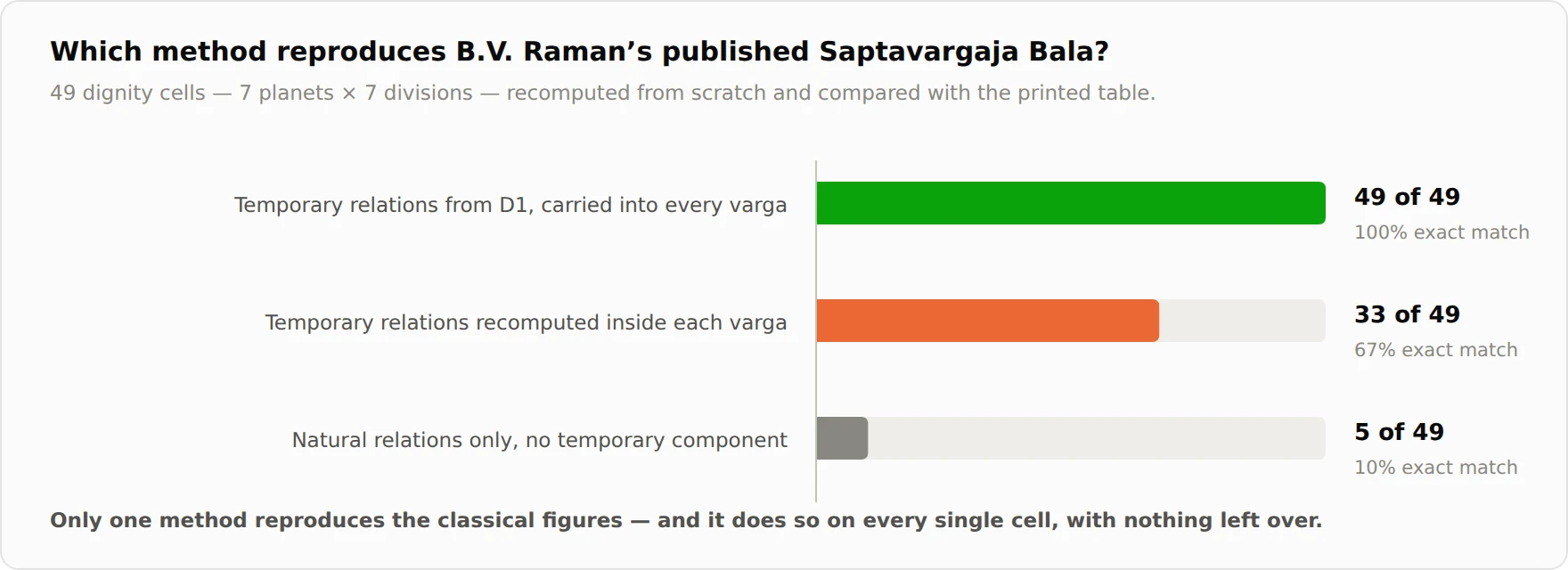
The result is not close. Taking the temporary relationships from the birth chart and carrying them into every division reproduces Raman’s table exactly — all forty-nine cells, every grade, every score, every total: Sun 90, Moon 48.75, Mars 90, Mercury 135, Jupiter 71.25, Venus 116.25, Saturn 97.5.
Recomputing inside each division breaks sixteen cells. The control — natural relationships only — matches almost nothing, which confirms the test is actually sensitive to what it claims to measure.
The cell where you can watch it happen
An aggregate match can feel like a conjuring trick, so it helps to look at one square of the table where the two methods visibly diverge.
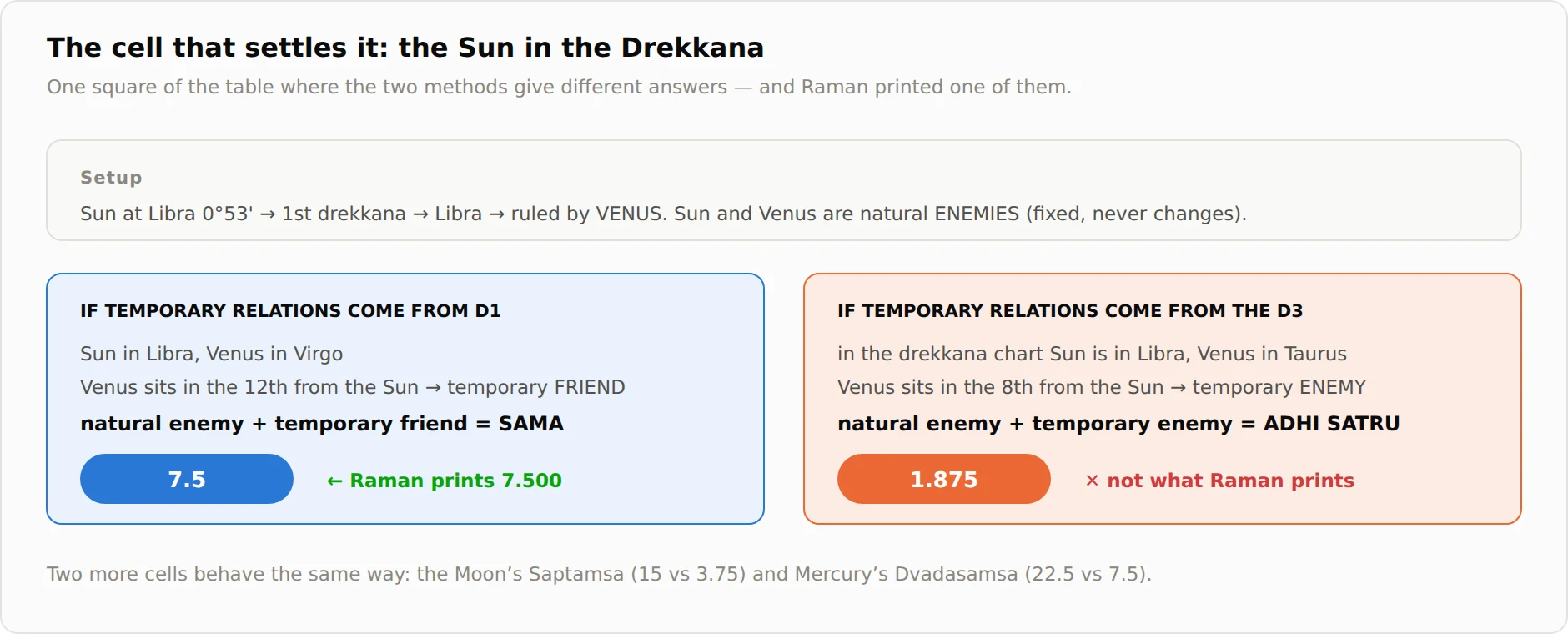
The Sun in this chart sits at Libra 0°53′. In the Drekkana, the first ten degrees of a sign map to the sign itself — so the Sun’s drekkana is Libra, owned by Venus. Sun and Venus are natural enemies; that much is fixed.
Now the disputed half:
- In the birth chart, Venus stands in Virgo — the twelfth from the Sun in Libra, inside the six-sign neighbourhood, so a temporary friend. Natural enemy + temporary friend = sama, worth 7.5.
- Inside the drekkana chart, Venus maps to Taurus while the Sun maps to Libra. Taurus is the eighth from Libra — outside the neighbourhood, so a temporary enemy. Natural enemy + temporary enemy = adhi satru, worth 1.875.
Raman prints 7.500.
Two other cells behave the same way and point in the same direction: the Moon’s Saptamsa (15 versus 3.75) and Mercury’s Dvadasamsa (22.5 versus 7.5). In every case the printed value is the birth-chart one.
And it is not a rounding-error-sized difference
It is tempting to file this under technical minutiae. The magnitudes say otherwise.
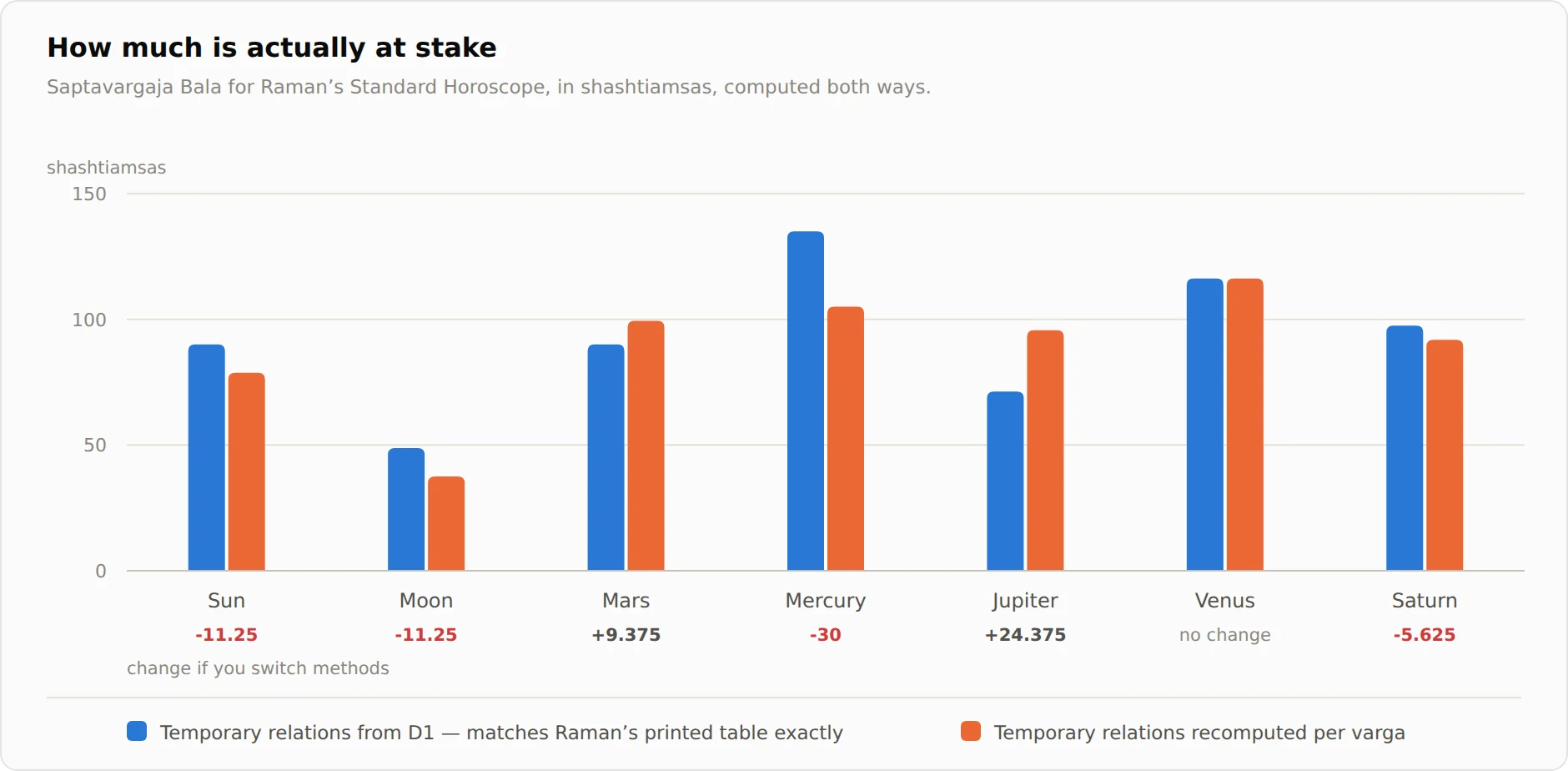
Switching methods moves Mercury’s Saptavargaja Bala down by 30 points and Jupiter’s up by 24 — and the Moon loses nearly a quarter of its score. Any judgement that leans on comparative planetary strength is being handed a materially different chart depending on which convention the software happens to implement.
Why the Rasi is the better answer
Set the arithmetic aside for a moment; the conceptual case runs the same way.
The word means “of that moment.” Tatkalika is built from tat (“that”) and kaala (“time”) — belonging to that occasion. The relationship is defined by where the planets actually stood relative to one another at the moment of birth. A varga is not a moment. Nobody was born at the Navamsa. It is an arithmetic transformation applied to a single planet’s longitude. There is no instant of time inside a divisional chart for a tatkalika relationship to belong to.
Varga “distance” is a by-product of the arithmetic. The temporary rule is, at bottom, a proximity rule — planets travelling together through the same stretch of the zodiac are companions. Every varga mapping destroys the property that rule depends on. Watch what happens to two planets standing a third of a degree apart:
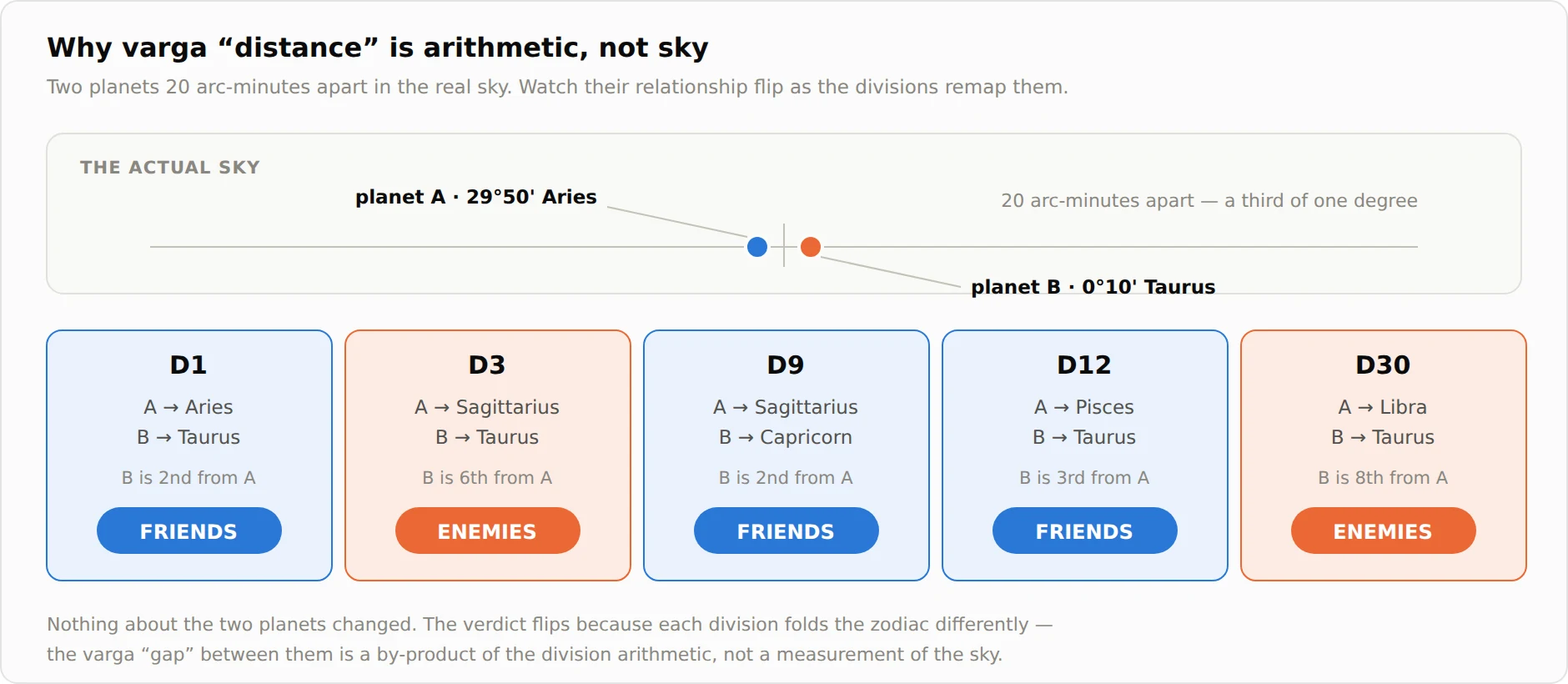
Twenty arc-minutes. In the real sky these two are practically touching. Yet the divisions fling them from adjacent signs to opposite corners of the chart and back again, and their “temporary relationship” flips from friend to enemy to friend to enemy purely as a function of which fold of the zodiac they land on.
The honest objection
The other side has a real argument, and it deserves to be stated at full strength rather than waved away.
If varga positions are too artificial to support a temporary relationship, then they are equally artificial for conjunction and for aspect — and virtually everybody, Ernst Wilhelm included, reads conjunctions and aspects within divisional charts. “Two planets in the same Navamsa sign” is exactly as much a by-product of the arithmetic as “two planets three Navamsa signs apart.”
Why it does not quite land
There is a defensible asymmetry here, and it is the same one visible in the panchadha maitri grid.
Conjunction and aspect in a varga are read as co-presence in a domain — a categorical, sign-based fact. Two planets in the same Navamsa sign says these two grahas both bear on this department of life. That is a claim about membership, and membership transfers to a varga naturally, because a varga is precisely an assignment of planets to signs. Natural friendship transfers for the same reason.
Tatkalika maitri is different in kind. It is a graded, distance-derived fact — it depends on counting how far apart two things are — and the varga mapping is exactly the operation that scrambles distance. That is why natural friendship carries into a varga without anyone objecting, while temporary friendship is the one ingredient people argue about.
What the programs actually do
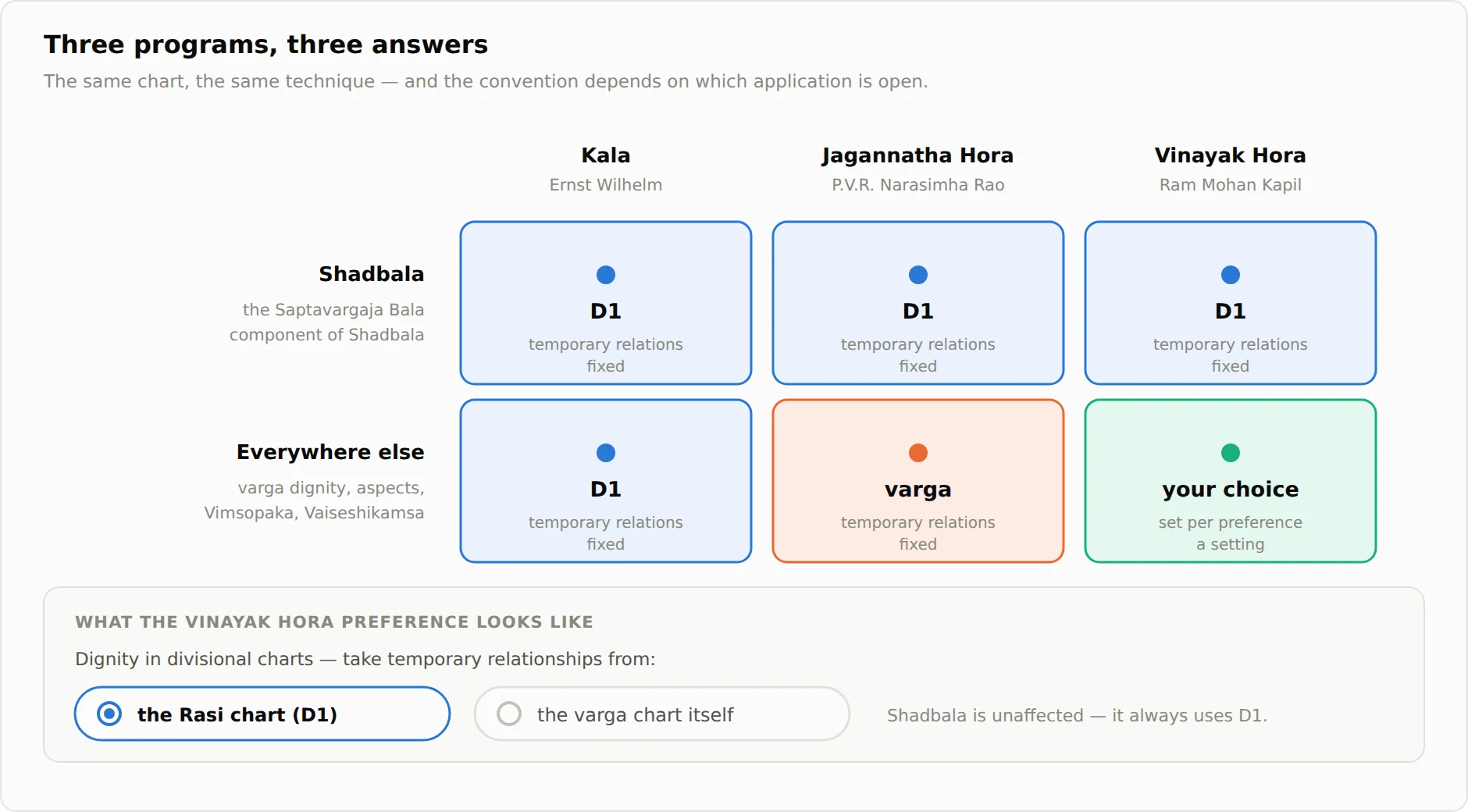
Kala takes the position described above throughout — the panchadha maitri matrix is built once from the Rasi and used everywhere.
Jagannatha Hora does two different things, and the split is principled rather than careless. Its Shadbala uses birth-chart temporary relations, because — as the test above shows — matching the published figures requires it; there is no interpretive freedom there. Everywhere else it recomputes inside the varga, which follows naturally from P.V.R. Narasimha Rao’s central doctrine that a divisional chart is a full chart in its own right. If you read aspects in the D-10 from D-10 positions, reaching back into another chart for one particular positional relationship would be inconsistent.
Vinayak Hora hard-codes only the part that is actually settled. For Shadbala, the Saptavargaja Bala component uses temporary relations taken from the Rasi chart, exactly as Raman’s tables require — that is not offered as a preference, because it is not one. Everywhere else, we ask. A setting on the preferences screen lets you choose whether varga dignity should read temporary relationships from the Rasi chart or from the varga in question.
We chose to expose it rather than decide for you, for three reasons.
It separates two different kinds of decision. Shadbala has a right answer in the narrow sense that it must reproduce published figures. Varga dignity has a disputed answer. Hard-coding both identically would misrepresent one of them.
It makes the assumption visible. The real damage in this dispute is not that practitioners disagree — it is that most of them do not know their software has already chosen. An astrologer comparing a Navamsa dignity across two programs can easily conclude one of them is broken, when both are correct implementations of different conventions. A setting written in plain language converts a hidden assumption into a stated one.
It makes the question testable. If you find the evidence above less than conclusive, you can settle it for yourself — score a set of charts with known outcomes both ways and see which sorts them better. That is trivial with a toggle and effectively impossible when the convention is compiled in.
What to set it to
Our recommendation is the Rasi chart, and we would give the same advice to someone using any other program.
Compute the panchadha maitri once, from the birth chart, and treat it as a constant of the nativity. Use it for varga dignity, for Vimsopaka Bala, for Vaiseshikamsa — anywhere a five-fold relationship is required. The relationship is a fact about the chart; the placement is what varies across sixteen divisions. Keeping those two things separate is cleaner, and it is what the classical arithmetic does.
Two practical cautions.
A setting is only a virtue if you know where it is set. A preference silently left on a default is functionally identical to a hard-coded convention, with the added hazard that you believe you chose it. Set it deliberately, note which way, and stay there.
Do not blend the two. These are two coherent systems, and a number produced by mixing them belongs to neither. If you compare charts scored under different settings, you are not comparing charts.
What this does not prove
A finding without its boundaries is just advocacy, so — plainly:
No verse forbids the varga method. The case here rests on the etymology of tatkalika, on the structural argument about which properties survive a varga mapping, and on Raman’s worked example. It does not rest on an explicit prohibition, because there isn’t one.
Raman represents the tradition; he is not the tradition. His procedure is a twentieth-century presentation of a classical method — the best available proxy, but a proxy.
Vimsopaka’s own textual basis is unclear. Whether Parasara intended the full five-fold relationship there, or a simpler exalted/own/friendly scheme, we could not pin to a verse. The 20/18/15/10/7/5 weighting is universal in practice; its provenance is another matter.
In one line
Tatkalika maitri means “the friendship of that moment” — and a varga is not a moment. Measure it once in the Rasi chart, carry it into every division, and your varga dignities will agree with the only classical calculation that can actually be checked. In Vinayak Hora the choice is yours to make; we suggest you make it once, in favour of the Rasi, and then leave it alone.
Bibliography
Everything asserted above can be checked. These are the sources it rests on.
Classical texts
- Brihat Parasara Hora Sastra, translated by R. Santhanam — full text. Chapter 3, verses 55–58: the natural, temporary and compound relationships, and the silence on vargas that this whole question turns on.
The benchmark calculation
- B.V. Raman, Graha and Bhava Balas: A Numerical Assessment of the Strengths of Planets and Houses (1996). Article 26 (the combined five-fold relationship) and Article 30 (Saptavargaja Bala), together with the Standard Horoscope’s longitudes and its printed forty-nine-cell table — the figures every claim in this post was tested against.
The two positions, in their authors’ own words
- Ernst Wilhelm, “Dignities in Vargas” — Kala software forum. The September 2020 and March 2021 exchanges, including the statement quoted above that temporary friendship is determined in the Rasi only.
- P.V.R. Narasimha Rao, Vedic Astrology: An Integrated Approach. The relationship definitions, and the doctrine that a divisional chart is a full chart in its own right — from which the per-varga convention follows.
- P.V.R. Narasimha Rao, Lessons on Vedic Astrology, Volume I. Lesson 3, on the three types of planetary relationship.
- Jagannatha Hora — feature list. The documented relationship-display and Vimsopaka features.
Corroborating technical sources
- Saravali, “Sthana Bala”. Confirms in plain terms that both conventions are genuinely in circulation: some hold temporary friendship is always relative to Rasi placement, others that it must be computed from the underlying varga.
- Vedic Mystics, “Vimsopaka Bala Example”. An independent statement of the same rule Ernst Wilhelm gives — that the panchadha sambandha should be evaluated from the D1 chart only.
- Vedic Mystics, “Vimsopaka Bala Calculation”. Source of the 20/18/15/10/7/5 weighting referred to above.
- Asheville Vedic Astrology, “Calculating Planetary Dignity and its Usefulness”. A standard modern statement of the temporary-friendship rule.