Ayana Bala: Two Ways to Measure the Same Thing (Classical Table vs Modern Trigonometry)
Where Ayana Bala fits in Shadbala
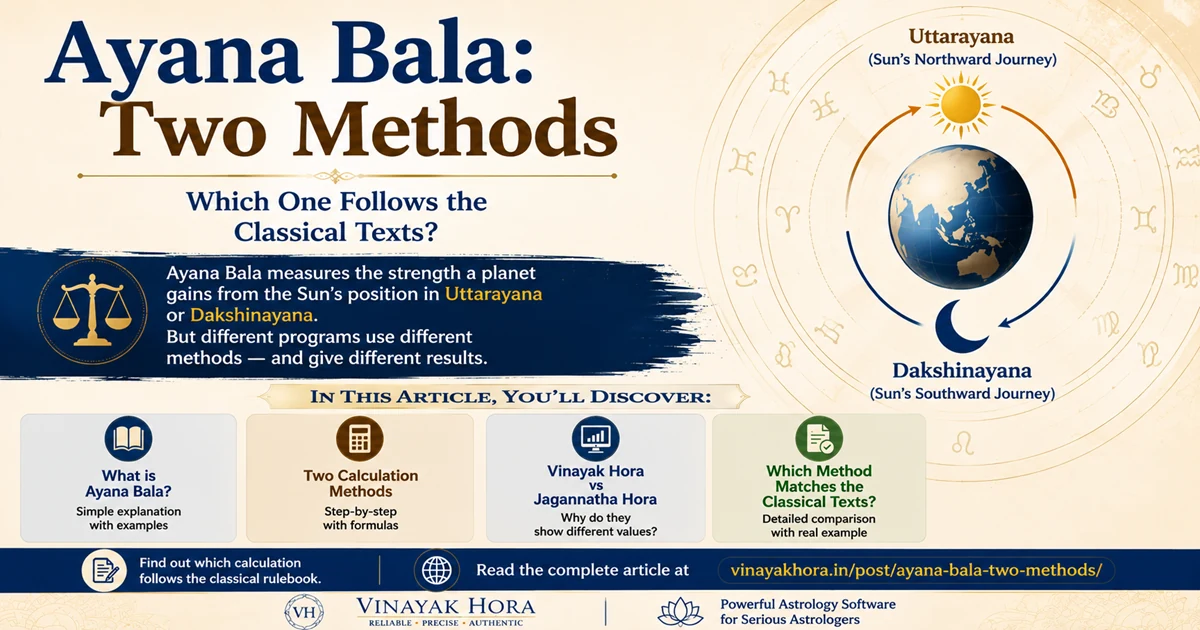
Shadbala (“six-fold strength”) measures how well-equipped a planet is to deliver its results. One of the six sources is Kaala Bala — strength that depends on time — and tucked inside it is Ayana Bala, the strength a planet draws from its northern or southern course.
An earlier post covered Natonnata Bala, the day–night component. This one takes up Ayana Bala, which is interesting for a different reason: there are two entirely defensible ways to calculate it, and they give slightly different answers.
The idea: north and south of the equator
As the Earth travels around the Sun, its tilted axis makes every planet appear to drift north and south of the celestial equator over the year. That north–south position has a name: declination, or kranti in Sanskrit.
The Sun’s declination is what gives us seasons. In late June it is about 23½° north (long days in India), and in late December about 23½° south (short days). Every other planet does something similar.
Classical astrology holds that planets have a preference:
| Group | Planets | Gains strength when… |
|---|---|---|
| North-loving | Sun, Mars, Jupiter, Venus | in northern declination |
| South-loving | Moon, Saturn | in southern declination |
| Both | Mercury | either way |
A planet in its favoured direction is rewarded; in the opposite direction it is penalised. At the two equinox points — where declination is zero — every planet scores exactly half marks, 30 points. The Sun’s result is then doubled, because its declination is the engine of the seasons.
Once you know a planet’s declination, the score follows a simple rule:
Ayana Bala = 30 × (24 ± declination) / 24
( + if the planet is in its favoured direction, − if not )
So everything hinges on one number: the declination. And that is exactly where the two methods part company.
Method 1: The classical kranti table
The classical texts were written for people computing by hand, without trigonometry tables or calculators. So they supply a lookup table.
You first reduce the planet’s longitude to a bhuja — its angular distance from the nearest equinox point, always between 0° and 90°. Then you read the declination off this table, interpolating within the 15° blocks:
| Block | Bhuja range | Value of block | Running total | Declination |
|---|---|---|---|---|
| 1 | 0°–15° | 362′ | 362′ | 6°02′ |
| 2 | 15°–30° | 341′ | 703′ | 11°43′ |
| 3 | 30°–45° | 299′ | 1002′ | 16°42′ |
| 4 | 45°–60° | 236′ | 1238′ | 20°38′ |
| 5 | 60°–75° | 150′ | 1388′ | 23°08′ |
| 6 | 75°–90° | 52′ | 1440′ | 24°00′ |
Notice the blocks shrink — 362, 341, 299, 236, 150, 52. That is the table quietly encoding a sine curve: declination climbs quickly near the equinox and flattens out near the solstice. It is an elegant piece of engineering, and it tops out at exactly 24°.
Vinayak Hora uses this method.
Method 2: Modern trigonometry
The modern approach computes declination directly:
sin(declination) = sin(longitude) × sin(obliquity)
where obliquity is the tilt of the Earth’s axis. This is not an approximation — it is the exact relationship, and a computer evaluates it instantly. Today’s obliquity is about 23.44°, not 24°.
“But the texts say 24° — is that an error?”
This is the most interesting part, and the answer is no.
The Earth’s tilt is not fixed. It drifts slowly, currently decreasing by about 47 arc-seconds per century. Running that backwards: an obliquity of 24° was correct roughly 4,000 years ago.
So the classical figure is not a rounding error or sloppiness. It is an accurate measurement — of the sky as it stood when those texts were composed. The tradition preserved the number faithfully; it is the sky that moved.
This is worth sitting with, because it reframes the whole comparison. The classical table is not “the crude version.” It is a careful, self-consistent system calibrated to its own epoch.
A worked example
Take the same illustrative chart used in the earlier post:
- Name: Rakesh Verma (illustrative)
- Born: 24 October 1972, 2:14 PM
- Place: Delhi
Let us compute the Sun’s Ayana Bala.
Step 1 — the Sun’s position on the seasonal circle. It is at 211.04°.
Step 2 — reduce to bhuja. Since 211.04° is past 180°, we take 211.04 − 180 = 31.04°.
Step 3 — read the table. 31.04° lands early in block 3 (30°–45°):
declination = ( 1002′ − (45 − 31.04) × 19.93′ ) ÷ 60 = 12.06°
Step 4 — which side? Longitudes past 180° are southern declination. The Sun is north-loving, so it is in its unfavoured direction and gets the minus:
Ayana Bala = 30 × (24 − 12.06) / 24 = 14.92
Step 5 — double it, because it is the Sun:
Ayana Bala = 29.84
Now the same Sun by modern trigonometry: sin(211.04°) × sin(23.44°) gives a declination of 11.84° — about 0.2° less than the table.
Here the modern method has to be consistent with itself: if declination is measured against today’s 23.44° tilt, then the scoring rule must use 23.44° as its ceiling too, not 24°. So:
Ayana Bala = 30 × (23.44 − 11.84) / 23.44 = 14.85, doubled = 29.70
Two respectable methods, a difference of about 0.14 points. That is the whole story in miniature.
Comparing two programs
Here is Ayana Bala for the same chart from Vinayak Hora and Jagannatha Hora, two widely used programs:
| Planet | Vinayak Hora | Jagannatha Hora | Difference |
|---|---|---|---|
| Sun | 29.84 | 30.23 | 0.39 |
| Moon | 5.32 | 5.45 | 0.13 |
| Mars | 22.37 | 22.60 | 0.23 |
| Mercury | 53.07 | 52.91 | −0.16 |
| Jupiter | 0.27 | 0.23 | −0.04 |
| Venus | 33.92 | 34.16 | 0.24 |
| Saturn | 0.71 | 0.74 | 0.03 |
(Values rounded to two decimals.)
A few things stand out.
The differences are small — under half a point, on a scale where Ayana Bala runs from 0 to 60 (0 to 120 for the Sun, which is doubled). In percentage terms they are around 1%.
They run in both directions. Jagannatha Hora is slightly higher for five planets and slightly lower for two. A genuine formula error — a wrong tilt value, a reversed north/south rule — would push consistently one way. A two-way scatter of this size points to a difference in numerical refinement, not a difference in doctrine.
Both programs sit close to the classical family. We tested this directly: recomputing the whole set with pure modern trigonometry moves the values further from Jagannatha Hora’s figures, not closer. So Jagannatha Hora is evidently not simply “the modern method” — it appears to apply its own refinement within the classical framework. Its exact variant is not documented publicly, and we make no claim to have identified it.
So which one is right?
Both are defensible, and it would be overreaching to declare a winner.
The honest position is this. Vinayak Hora implements the classical prescription as written — the traditional table, the traditional 24° — and does so faithfully and transparently. If you want to know why your chart shows a particular number, you can follow every step by hand, exactly as above. That transparency is deliberate.
A program using exact trigonometry is, strictly speaking, computing declination more precisely — but “more precise” is not automatically “more correct” here, because the classical scoring rule was designed around the classical table and its 24° ceiling. Mixing a modern declination into a formula calibrated for 24° introduces a small inconsistency of its own. There is a real argument for keeping the system internally coherent, which is the choice Vinayak Hora makes.
And the practical consequence? There isn’t one. A third of a point in Ayana Bala does not move a planet from strong to weak, does not change which planet is strongest in a chart, and does not alter a single interpretation. Ayana Bala is one component of Kaala Bala, which is itself one of six sources of Shadbala.
If your two favourite programs disagree here by a few hundredths, nothing is broken in either of them. You are simply watching a four-thousand-year-old measurement and a modern one, both doing their job, differing by about 1%.
In one line
Ayana Bala rewards a planet for being on its preferred side of the celestial equator. Getting there requires a planet’s declination — and whether you read that from a classical table calibrated to a 24° tilt, or compute it from today’s 23.44°, you will land within about a percent of each other. The tradition, it turns out, built better tools than it is usually given credit for.