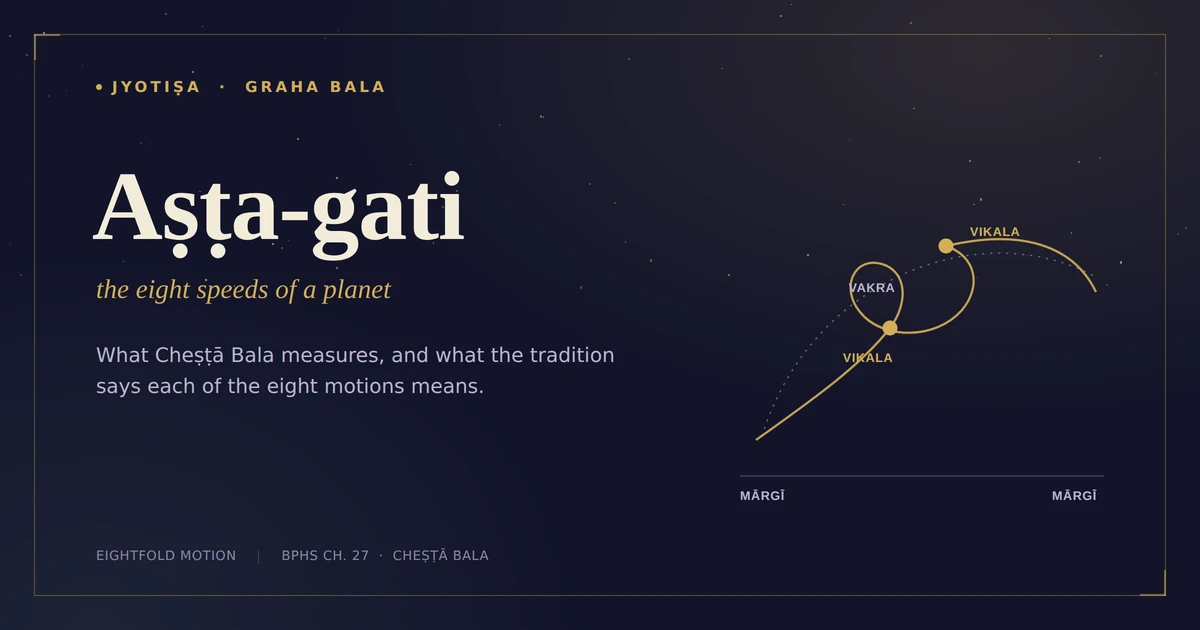
Aṣṭa-gati: The Eight Classical Speeds of a Planet, and the Cheshta Bala
Watch Mars over a few months and something strange happens. It slows, stops dead against the background stars for the better part of a week, and then appears to travel backward — looping westward through the zodiac before it stops again and resumes its normal eastward march. Mercury and Venus do a faster, twitchier version of the same thing several times a year.
To an astronomer this is a solved problem — Earth periodically overtaking a slower outer planet, or being overtaken by a faster inner one. To Jyotisha it is data. The tradition does not just note that a planet is fast, slow, or reversing — it grades the motion on an eight-point scale, assigns each grade a numeric strength, and folds that number into how the planet is read. That scale is what practitioners call Aṣṭa-gati — “eightfold motion.”
This post lays out where the scale comes from, what the classical texts say it does, and how four contemporary teachers — Sanjay Rath, Visti Larsen, P.V.R. Narasimha Rao and Ernst Wilhelm — read it. It is a companion piece to the Ayana Bala and Natonnata Bala posts on this site: all three are components of the same six-fold strength system.
Where the scale comes from: Cheshta Bala
Shadbala — “six-fold strength” — measures how well-equipped a planet is to deliver its results. One of the six sources is Cheshta Bala, “the strength of effort”: strength drawn purely from how a planet is moving at the moment being judged.
Brihat Parashara Hora Shastra (BPHS), chapter 27, lays out eight named states a planet’s motion can be in and assigns each one a strength value — in units called virupa — that feeds into the Cheshta Bala total.
“Eight kinds of motions are attributed to graha: Vakra, Anuvakra, Vikala, Manda, Mandatara, Sama, Chara, and Atichara… the resultant Cheshta-kendra, converted to degrees and divided by three, denotes the motional strength of the graha.” — Brihat Parashara Hora Shastra, ch. 27
Here is the scale, running from full reverse to an unremarkable, textbook pace:
| Gati | What’s happening | Motion | Virupa |
|---|---|---|---|
| Vakra — retrograde | Moving backward through the sign | Retrograde | 60.0 (max) |
| Anuvakra — “after-retrograde” | Retrograde motion spilling back into the previous sign | Retrograde | 30.0 |
| Vikala — stationary | The turning point itself; motion is briefly nil | Stationary | 15.0 |
| Manda — slow | Forward, distinctly slower than average | Direct | 30.0 |
| Mandatara — slower still | Forward, slower again than Manda | Direct | 15.0 |
| Sama — even | Forward, at an unremarkable, average pace | Direct | 7.5 (min) |
| Chara — fast | Forward, faster than average | Direct | 45.0 |
| Atichara — very fast | Forward and fast enough to jump into the next sign early | Direct | 30.0 |
Look at the numbers and a pattern emerges: this is not a simple ranking from slow to fast. The scale rewards departure from the ordinary, in either direction — and it rewards backward motion more than even the fastest forward motion. A planet doing exactly what is expected of it, cruising at its textbook mean rate, is graded the weakest of all eight states. The one thing this scale punishes is being unremarkable.
Only five planets ever go through the full cycle — Mercury, Venus, Mars, Jupiter and Saturn, the ones close enough or far enough from the Sun to show apparent retrograde motion from Earth. The Sun and Moon never retrograde, so BPHS substitutes Ayana Bala and Paksha Bala for them respectively wherever Cheshta Bala would otherwise apply. And BPHS does not actually require picking one of the eight buckets by eye — it also gives a continuous formula (average a planet’s mean and true longitude, measure the gap from its Sighrocca, divide by three) that most modern software, including Jagannatha Hora, uses to compute an exact value rather than a category.
What the older texts say it means
BPHS hands you the arithmetic. It is the texts that follow it — and the practitioners reading them today — who spell out what a given Cheshta Bala actually predicts.
The line every later writer on this topic seems to circle back to is from Mantreshvara’s Phaladeepika:
“A retrograde planet in its sign of debilitation is equal to its occupation of its exaltation sign.” — Mantreshvara, Phaladeepika
That is a large claim — retrogression is treated as strong enough to flip the ordinary reading of planetary dignity on its head. It sits alongside the same logic behind Neechabhanga, cancellation of debilitation: a planet that looks weak by placement can, retrograde, act with real force.
Kalyanavarma’s Saravali (ch. 5) adds the rule most practitioners still lead with — retrogression does not change a planet’s basic nature, it turns up the volume on it:
“A benefic, if retrograde, is strong and capable of conferring a kingdom. If a malefic is retrograde, it causes grief and purposeless wandering.” — Kalyanavarma, Saravali, ch. 5
A well-disposed planet gets better; a badly-disposed one gets worse. Later digests such as Uttara Kalamrita extend the same principle.
Brihat Jataka (Varahamihira) ties speed directly into longevity math: a planet that is both retrograde and exalted is given a triple multiplier in some Ayurdaya (lifespan) calculations, and a double multiplier when merely well-placed in a varga — retrogression compounding other strength rather than simply coexisting with it. And Sanketa Nidhi extends the idea into house results: a retrograde planet, in this reading, delivers effects tied to the house behind the one it currently occupies, its influence smeared backward across two houses instead of confined to one.
Four modern teachers, one shared foundation
Contemporary Jyotisha has not replaced any of this — Cheshta Bala is still Cheshta Bala. But how different teachers use the concept in a live reading varies, and it is worth being honest about how well each position is actually documented from their own published words.
Visti Larsen (Sri Garuda) has the clearest published take of the four. He collapses the eight states into a three-part model built on the three gunas: direct motion is rajasic — the planet actively pursuing its significations; the stationary turn is sattvic — a recharging pause; retrograde motion is tamasic — the planet returning with stored-up intensity. From there he draws a genuinely useful, double-edged rule: a retrograde malefic sitting in its own sign or exaltation, in a kendra or trikona, reads as devastating — its tamasic charge amplifying damage from a position of strength. The same placement in a dusthana can instead produce Vipareeta Raja Yoga — the planet’s destructive energy turned against the houses of loss rather than the native. Retrograde benefics work the same way in reverse.
Sanjay Rath’s Sri Jagannath Center teaches Cheshta Bala the long way — the full Cheshta-kendra formula, not a shortcut through the eight fixed buckets — folded into the wider architecture of Shadbala rather than treated as a standalone doctrine. A theme associated with this lineage, consistent with the plain sense of vakra (“to turn, to bend back”), reads retrograde periods as karmic matters that have to be revisited or repeated before they resolve. Worth flagging plainly: this research could not track down a directly quotable primary statement from Rath laying out the eightfold scale’s effects in his own words — the summary above reflects course material and secondary notes, not verified primary text.
P.V.R. Narasimha Rao’s clearest contribution here is technical rather than doctrinal: Jagannatha Hora, the free software he authored, implements Cheshta Bala with the full classical formula and is one of the tools that made precise, sign-by-sign speed-tracking routine outside specialist software. His introductory lessons define retrogression in plain terms, as groundwork for the standard Shadbala treatment — this research did not find an independent interpretive framework attributed to him beyond faithful implementation of the classical method.
Ernst Wilhelm’s major relevant work, Graha Sutras, is presented as a deliberately literal re-translation of BPHS’s planet-by-planet material — the project is a more precise BPHS, not a competing theory of what speed means. Wilhelm is separately known for treating a planet’s visibility, brightness and closeness to Earth as live variables, which sits naturally next to gati — but this research could not verify a specific statement connecting that interest directly to the eightfold scale, so it is flagged rather than asserted.
What the tradition reads into speed
Strip away the Sanskrit and the arithmetic, and Aṣṭa-gati is making one consistent argument: a planet doing something unusual — reversing, stalling, or sprinting — is a planet worth paying closer attention to, and the tradition reads that attention-grabbing behaviour as more, not different. More of whatever the planet already promised, for better or worse, depending on what kind of planet it is and where it is standing when it does it.
A few threads worth holding onto:
- Amplification, not reversal. Retrogression does not flip a planet’s nature — it turns up the volume on it. A retrograde benefic tends toward its best outcomes; a retrograde malefic toward its harshest.
- Debility overturned. Retrogression is one recognized route to Neechabhanga — a planet that looks weak by sign can, retrograde, act with real force.
- The stationary point (Vikala) is widely treated as concentrated, unreleased force — motion converted to potential rather than absent.
- Results, deferred and repeated. Retrograde periods are often read as matters requiring repetition before they resolve — results that land later, but land harder once they do.
- House results shift back. A retrograde planet is read as also delivering results tied to the house behind its current position.
- Fast versus slow, apart from retrogression. Even in direct motion, unusually fast (Chara/Atichara) movement is treated as restless and quickly spent, and unusually slow (Manda/Mandatara) movement as deliberate and consequential once it finally lands.
It is a small piece of the larger strength system, not a verdict on its own. But it is a good reminder that even in a chart cast once at birth, the sky it was drawn from was never actually still.
Where a claim about a specific teacher’s views could not be independently verified against their own published words, that is noted in the text above rather than presented as settled. Sources: Brihat Parashara Hora Shastra ch. 27, Phaladeepika, Saravali, Brihat Jataka, and published material from Visti Larsen, Sanjay Rath, P.V.R. Narasimha Rao and Ernst Wilhelm.